
Welcome to the second edition of our OnePage Insight series! In these sessions, we’ll explore considerations in renewables, condensing them into easy-to-digest, one-page insights. This second insight focuses on the material Perovskite and its application in solar panels.
What is perovskite?
The term perovskite refers to a class of materials that share the same crystal structure as the naturally occurring mineral perovskite, calcium titanate (CaTiO3).
This mineral was discovered in the Ural Mountains by the Russian mineralogist Lev Perovski (1792–1856). Perovskite is a colourless, diamagnetic solid that naturally crystallises in orthorhombic form.[1]
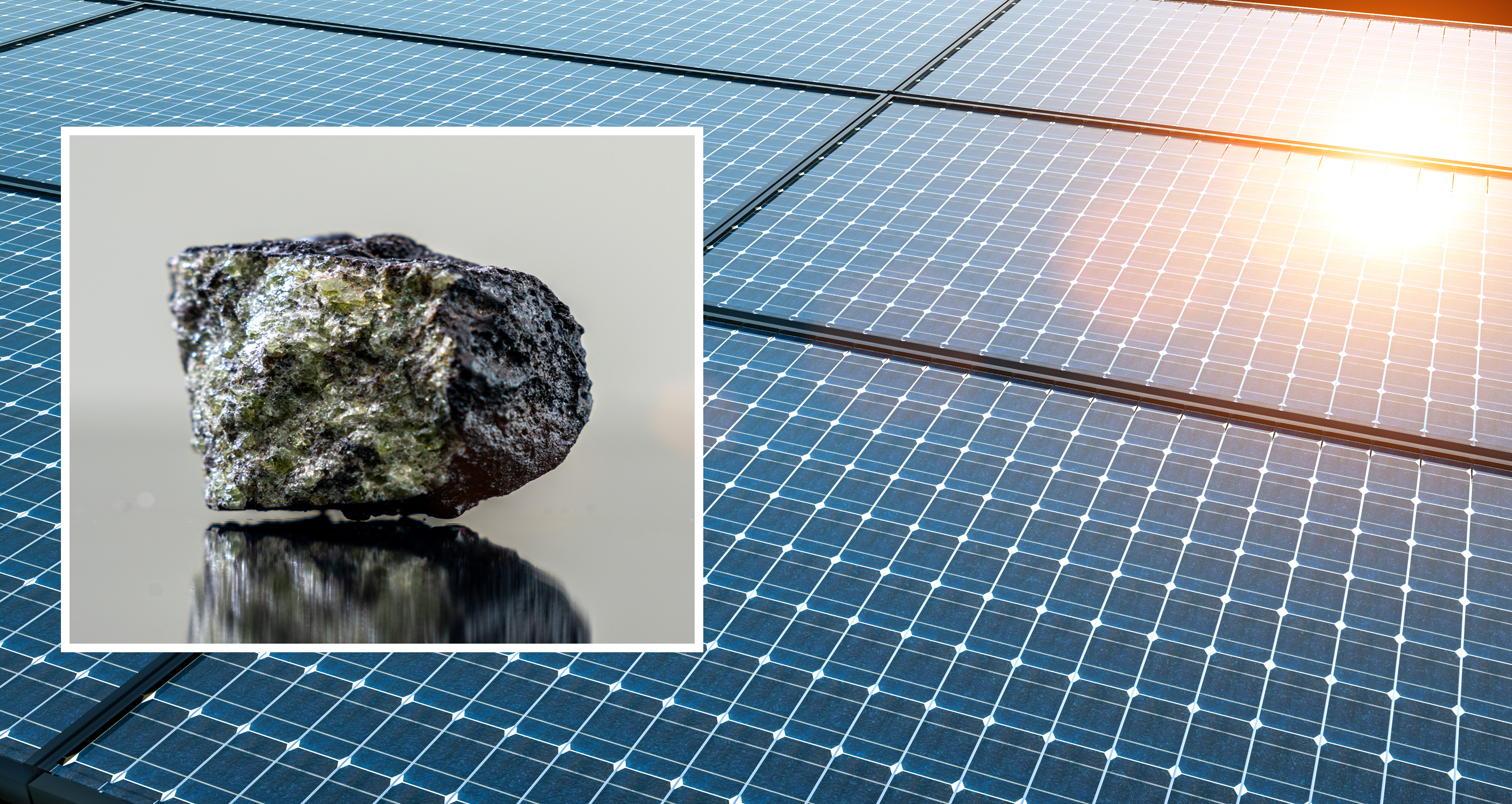
Following the mineral's initial identification, in 1892 Horace L. Wells of the Sheffield Scientific School at Yale University successfully synthesised the inaugural synthetic halide perovskite, a compound comprising Caesium (Cs) and Lead (Pb). Halides are defined as binary compounds formed from a halogen and another element.
Nowadays, the perovskite structure is capable of being produced in a relatively straightforward manner through a variety of chemical and industrial processes. Numerous materials exhibiting a similar crystal lattice, commonly represented by the formula ABX3, are also designated as perovskites. The majority of these are inorganic compounds that replicate the structural characteristics of the original mineral.
The total number of known minerals is limited, at approximately 5,000. Despite its rarity, natural perovskite is valuable as a titanium-bearing ore and has been found in several locations worldwide, including Switzerland, Italy, the U.S. state of Arkansas, and the Ural Mountains.
Perovskite solar cells
These materials have attracted significant attention due to their exceptional light-absorbing properties and low manufacturing costs.
The composition of these solar materials typically involves a combination of organic molecules and metals, including lead and tin, in addition to halides such as iodine, bromine, and chlorine. The composition of the material results in the formation of a crystal structure, which functions as an efficient converter of sunlight into electricity.
Perovskites are a class of materials that exhibit a number of advantageous properties that make them suitable for use in photovoltaic applications. These properties include excellent light absorption, efficient charge transport, and tunable band gaps.[2]
A salient benefit of perovskite solar cells is their rapid enhancement in efficiency. In the span of approximately ten years, the efficiency of power conversion has seen a substantial enhancement, rising from approximately 3–4% to over 25%.[3] This progression is approaching the performance levels exhibited by conventional silicon solar cells. Furthermore, perovskites can be produced using low-temperature solution processes, which has the potential to significantly reduce manufacturing costs compared to conventional silicon panels.
Nevertheless, a number of challenges still limit their widespread commercial adoption. These include long-term stability, sensitivity to moisture and heat, and concerns about lead toxicity in many perovskite formulations.[4,5,6] Researchers are currently engaged in endeavours to enhance durability, develop protective encapsulation techniques, and explore lead-free alternatives. I contributed to this effort by synthesizing lead-free all-inorganic halide perovskite derivative, namely Cs3Cu2I5 as a lead-free option for thermoelectric generators (TEGs).
Perovskite materials are considered to be among the most promising emerging technologies in solar energy and have the potential for more economical, lightweight and effective photovoltaic systems, thus expediting the global transition towards renewable energy sources.
Perovskite tandem solar cells
Perovskite tandem solar cells are composed of a perovskite absorber that is integrated with another photovoltaic material, most frequently crystalline silicon. This configuration results in the creation of a multi-junction device that is designed to enhance the comprehensive utilisation of the solar spectrum. In these architectures, a wide-bandgap perovskite top cell absorbs high-energy photons, while the lower-bandgap silicon bottom cell captures lower-energy light. This reduces thermal losses and enables higher power conversion efficiencies than single-junction cells can achieve.[7]
In recent years, there has been rapid advancement in perovskite/silicon tandem cells, with certified efficiencies approaching 35%. This surpasses the 28% efficiency limit of single-junction silicon cells, exceeding the practical limits of conventional silicon technology. This positions perovskite/silicon tandem cells as one of the leading next-generation photovoltaic solutions.[8] Research continues to concentrate on improving stability, interfacial engineering, and scalable manufacturing to realise commercial deployment.
To learn more about Crawford’s Renewable Energy Practice, visit our Power and Renewable Energy page.
Disclaimer:
This article is intended for general informational purposes only and summarises current research and development activity. Any references to efficiency, cost, performance, or sustainability outcomes are based on laboratory‑scale or research‑stage findings and do not represent commercial‑scale performance, availability, or guaranteed environmental impact.


